
How to Get Clients on LinkedIn: The Complete Guide
 Bas Smeets18 min read
Getting clients on LinkedIn comes down to three things done consistently: a profile that speaks directly to the people you help, content that makes them feel understood, and conversations that build trust before anyone mentions a discovery call.
In this guide:
Why is LinkedIn the best platform for getting coaching clients?
How do you set up your profile to attract clients, not followers?
What content actually gets you coaching clients on LinkedIn?
Where do you find content ideas that resonate with your ideal client?
How do you turn LinkedIn engagement into real conversations?
What should you say in LinkedIn DMs to get clients without pitching?
What mistakes stop coaches from getting clients on LinkedIn?
When coaches hear "get clients on LinkedIn," the first image is usually a DM that reads like a cold pitch dressed up as a compliment. That approach is everywhere and it does not work. It is not what this guide is about.
The coaches who consistently fill their practices through LinkedIn figured out something different: how to be genuinely useful in public, often enough that the right people start coming to them. That is the whole model. This guide covers every part of it, step by step.
I've seen it countless times with the coaches in our own coachteam for my Passion Profile business: Suddenly people start telling you that they've seen you on LinkedIn. But honestly, it takes a bit of time. One of our coaches, Gerard, had been posting actively for about 3 months and was slowly getting frustrated with the results. But then suddenly people started booking calls with him and mentioned seeing his LinkedIn posts.
Why is LinkedIn the best platform for getting coaching clients?
Your ideal clients are already on LinkedIn, and they are there in a specific headspace. Not scrolling for entertainment. They are checking their industry, watching what peers are doing, and quietly aware that something in their work is not clicking. Every time a professional opens LinkedIn, they are in problem-solving mode. That is exactly the space a good coach occupies.
Compare that to Instagram or TikTok, where people are looking to be entertained. LinkedIn users are open to ideas that help them think through a problem. A career coach, executive coach, or life coach has a ready-made audience of professionals who are already asking the questions coaching helps answer.
The organic reach on LinkedIn is also still genuinely strong compared to other platforms. Personal posts from individual accounts consistently outperform company page content. You do not need a media budget or thousands of followers. You need the right 300 people to know you exist and trust you.
Worth knowing
LinkedIn drives more B2B leads than any other social platform, but coaching is different from B2B sales. Coaches are not selling a product with a defined spec. They are earning trust for something personal. That changes the approach significantly, which is why generic LinkedIn advice often fails coaches.
How do you set up your profile to attract clients, not followers?
Before you write a single post, your profile needs to work. Someone who finds you through content and clicks through to your profile has maybe 10 seconds before they decide whether to follow you, connect, or leave. Most coaching profiles lose people in those 10 seconds.
The three elements that do the most work:
Your headline
The most common coaching headline looks like: "Executive Coach | ICF Certified | Leadership Development." That tells another coach where you sit in the professional landscape. It tells a potential client nothing useful.
A formula that works: "I help [specific type of person] [achieve specific outcome or solve specific problem]." Your headline appears everywhere on LinkedIn, in search results, comment sections, connection requests. Write it for your ideal client, not your peers. Our full guide to LinkedIn profile optimization covers every section in detail.
Your About section
Most coaches write their About section like a biography. Qualifications, career history, coaching philosophy. The person reading it does not care about any of that yet. They care whether you understand their situation.
Write in first person. Speak to the reader directly. Open with a line that names their experience, not yours. "If you have spent the last five years building a career that looks successful from the outside but feels wrong from the inside, you are in the right place." That is a first sentence that earns the next one.
A clear next step
Add a booking link or a DM invitation in your Featured section and at the end of your About section. A profile with no obvious next step creates a dead end. Someone who was almost ready to reach out will click away and never come back. Make it easy. Use our free bio generator to draft an About section with a built-in CTA.
Start here
If your profile needs work, fix these three things first: headline, About section, Featured section. Those three changes will move the needle faster than anything else. Do not wait until the whole profile is perfect before starting to post.
What content actually gets you coaching clients on LinkedIn?
Here is the category error that trips coaches up constantly: they post about coaching when they should be posting about the problems their clients have. Those are not the same thing, and the difference is everything.
Content that attracts clients falls into three categories. You need all three, rotating across the week.
Empathy content
This makes your ideal client feel seen. It describes their inner experience so accurately that they stop scrolling because they think you are talking directly to them.
Example: "You wake up Sunday already dreading Monday. Not because you hate your job. Because you have been doing the right thing for so long that you have completely lost track of what you actually want." That kind of post generates comments that start with "this is literally me right now." Those are your warm leads.
Authority content
This shows how you think. Your methodology, your perspective, the things you believe about your niche that most people do not say out loud. "Most people treat career decisions like logic problems. In my experience, they are almost always identity problems." A post like that attracts people who think the way you think, which means they are already aligned with your approach before they book a call.
Social proof content
This is the most underused category. Coaches avoid client stories because they feel like bragging. They are not. They are evidence. A specific, anonymised account of someone who arrived stuck and left with clarity does more for your practice than ten methodology posts. "A client came to me stuck after 12 years in the same role. Eight weeks later, she had accepted a completely different offer and said it was the first career decision she had made that felt entirely hers." Keep the client anonymous. Focus on the transformation.
Content ratio to aim for
Two empathy posts, one authority post, one social proof post per week. That balance covers the full trust-building journey a potential client goes through without your feed starting to feel like a highlight reel.
Before you hit publish on anything, ask one question: what does this do for the person reading it? If it is answering that question for you more than for them, rewrite it. Our complete LinkedIn content strategy guide covers formats, hooks, and the full system in detail.

How often should you post to get clients on LinkedIn?
Two posts per week is the floor. Not five, not daily. Two well-crafted posts per week, sustained over months, will build a real audience. Below two per week, the algorithm deprioritises your content and your audience loses the thread of who you are.
Stage | Recommended cadence | Focus |
|---|---|---|
Just starting out | 3x per week | Volume: learn what resonates before optimising |
Building momentum | 3x per week | Quality improving, doubling down on what works |
Established practice | 2-3x per week | Fewer, better posts reaching more people |
Full client load | 2x per week minimum | Client stories and insights to stay visible |
Irregular posting is worse than posting less
Two posts per week, every week, for six months will outperform a sprint of daily posting followed by two months of silence. The algorithm deprioritises accounts that go quiet, and your audience forgets you faster than you would expect.
Set aside 90 minutes once a week and write everything for the coming week in one session. Once you are in writing mode, the second and third post come much faster than the first. Most coaches find this significantly less painful than trying to write something fresh every day. How to batch-create a month of LinkedIn content covers this system in full.
Where do you find content ideas that resonate with your ideal client?
The best source is the session you just finished. Not a vague memory of it, but the specific moment something shifted. The question that surprised you. The phrase a client used that articulated something perfectly. The belief that was holding someone back that you know is universal.
A five-minute note immediately after a session is all you need. Over time, that habit becomes a content bank that never runs dry. One real insight from a single session can become three different posts: a pain-point version, an authority version, and a story version.
Other reliable sources:
Questions you have answered more than three times this month
Conventional wisdom in your niche that you think is wrong
Moments from your own career that connect to what your clients go through
The gap between what clients say they want when they first reach out and what they actually need
The post idea that always works
Think of a belief your ideal client holds that is keeping them stuck, one you push back on in almost every intake conversation. Write a post that names that belief and offers a different frame. That post will feel uncomfortably direct to write and will generate the most meaningful engagement you have seen.
If you're a CoachCraft user, you can see which types of posts perform best on your analytics page. What we see is that personal story posts about beliefs you once had and your clients recognize do really well.
How do you turn LinkedIn engagement into real conversations?
A pattern that kills many coaching LinkedIn strategies: a coach writes a good post, gets some engagement, and does nothing with it. The engagement sits there, untouched, while the opportunity fades.
LinkedIn rewards activity in the first 60 to 90 minutes after you post. Respond to every comment in that window, not with "thanks!" but with a real reply that continues the conversation. This matters algorithmically since engagement signals the platform to show the post to more people. But it matters more relationally. The people commenting on your posts are self-selecting as interested in your ideas. That is the start of something worth nurturing.
The second part of engagement is commenting on other people's content. Spending 15 minutes before you post, commenting thoughtfully on posts from people in your ideal client's world, puts your name and perspective in front of exactly the right audience. When those people click through to your profile, they arrive already primed by the quality of your thinking.
Comments beat likes
LinkedIn's algorithm values comments significantly more than likes. A post with 10 thoughtful comments reaches more people than a post with 100 likes and no conversation. Write posts that invite response, not just agreement.
For coaches specifically, the goal of engagement is not virality. It is visibility to the right people. A post that gets 8 likes but prompts 2 DMs from ideal clients is outperforming a post with 200 likes from people who will never hire you. The content-to-consultation funnel covers how to move someone from casual engagement to a booked discovery call.
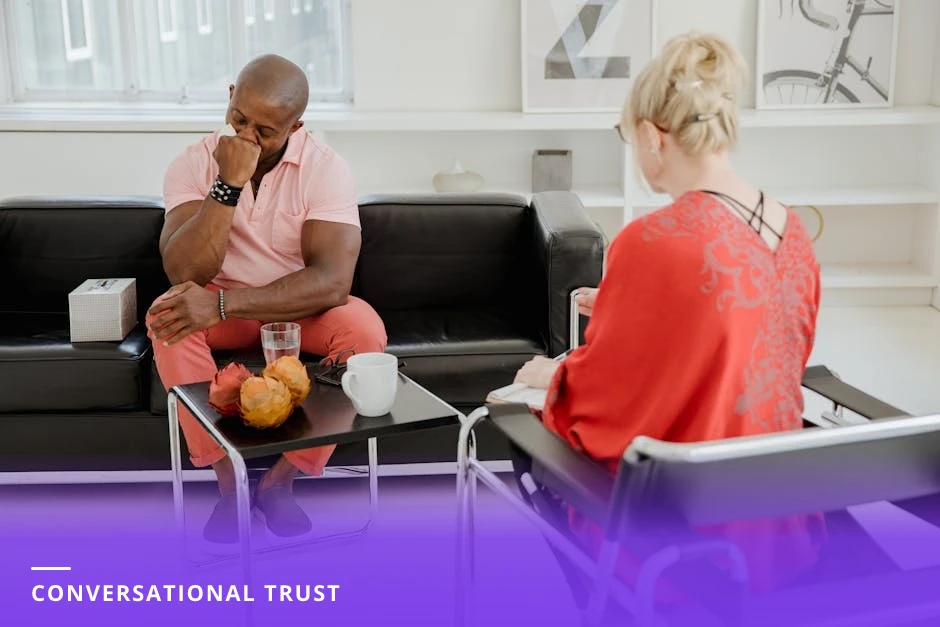
What should you say in LinkedIn DMs to get clients without pitching?
Never pitch on a first message. The "congrats on your work anniversary, here is my coaching offer" message is instantly recognisable and nobody responds well to it. It is not just annoying, it is counterproductive. It signals that you did not pay attention to anything about this person before deciding they needed your help.
What actually works is simpler: be a person first, a coach second. When someone engages with your content in a way that suggests they are dealing with something you recognise, a genuine, specific message is appropriate.
A DM that does not sound scripted
"Hey [name], your comment stuck with me, specifically what you said about [specific thing they said]. That comes up a lot in my work. Is that an active challenge right now, or more of a longer-term frustration?"
That is it. No pitch. No offer. Just a genuine question based on something real they said. From there, you are in a conversation. Discovery calls come out of genuine conversations.
The transition from conversation to discovery call is natural when the timing is right. After a few exchanges where you have both been real about what they are dealing with, something like "this sounds like exactly the kind of thing I work through with people, would it be useful to have a proper conversation?" is not a pitch. It is an invitation that makes sense given what you have already discussed.
Our full LinkedIn DM strategy guide covers the complete warm DM framework, including how to identify the right moment to make that move.
How long does it take to get clients from LinkedIn?
Most coaches see their first genuine inbound enquiry from LinkedIn content between 6 and 12 weeks of consistent posting at 2-3 times per week. Not virality, just people who found them through content and wanted to learn more. That timeline assumes the profile is set up correctly and the content is speaking to the right audience.
Here is roughly what to expect month by month:
Month 1: Almost nothing visible. The algorithm is learning your account. This is not failure, it is normal. Keep going.
Month 2: Occasional engagement from people outside your existing network. Profile visits starting to tick up. A comment here and there from someone you do not know.
Month 3: The compound effect becomes visible. Posts are reaching further. Someone DMs you about working together. It usually starts happening around here.
Month 4-6: Consistency is paying off. Inbound enquiries are no longer a surprise. The people who reach out are already warm because they have been reading your content for weeks.
The coaches who do not see results are not posting badly
They stop too early. Month one always looks like nothing is happening. The ones who make it to month three consistently are usually the ones who end up with a full practice from LinkedIn.
This confirms what we see in our own data at CoachCraft. Coaches that post consistently for at least 3 months start to see real results (=actual clients from LinkedIn).
What mistakes stop coaches from getting clients on LinkedIn?
Most of them come down to one root cause: treating LinkedIn like a broadcast channel instead of a trust-building one. Here are the specific patterns that show up most often.
Writing for other coaches instead of for clients
When you post about coaching frameworks, methodology insights, or industry observations, the people who engage are other coaches. That is because the post was written in coaching language, not client language. "Values alignment in career decision-making" is coaching language. "You keep taking jobs that look perfect on paper and feel wrong within three months" is client language. Same topic, completely different response.
Posting without engaging
LinkedIn is not a broadcast platform. Coaches who post and disappear are using half the tool. The first hour after a post goes live is the most important. Respond to every comment. Engage with others' content before and after you post. The algorithm treats active participants differently from people who only publish.
Stopping too early
Already covered above, but worth repeating: most coaches who give up do so just before the compound effect would have kicked in. Six weeks of consistent posting feels like nothing. Six months looks completely different.
Pitching too early in DMs
A pitch in the first DM is the fastest way to get ignored and occasionally reported. The coaches who convert DM conversations into clients are the ones who have real conversations first. Trust comes before the offer, not the other way around.
Optimising for likes instead of clients
A post that gets 200 likes from other coaches is not performing. A post that gets 8 likes and prompts 2 DMs from ideal clients is doing its job. Track profile visits, inbound DMs, and discovery calls. Those are the metrics that tell you whether LinkedIn is working for your practice.
What I see as the single biggest reason coaches fail on LinkedIn is that they give up too early. They don't see the likes or reactions, their inbox stays empty and after a couple of weeks they just give up.
You know what I learned? The people that actually become your clients aren't the ones liking and reacting! Most of the time they are the quiet readers. So just keep going.
Frequently asked questions
How many LinkedIn followers do you need to get coaching clients?
Far fewer than most coaches think. The coaches who generate consistent client enquiries from LinkedIn often have under 1,000 followers. What matters is not the size of your audience but how relevant it is. Three hundred people who match your ideal client profile will generate more business than ten thousand random followers.
Should coaches use LinkedIn Premium to get more clients?
For most coaches, it is not necessary. LinkedIn Premium gives you InMail credits and additional profile views data, but the organic approach described here does not require it. Invest the subscription cost in improving your content or profile before adding Premium.
How do you find coaching clients on LinkedIn without cold outreach?
Post consistently about the problems your ideal clients have. Engage genuinely with people who respond to your content. When someone engages repeatedly and their comments suggest they are dealing with something you recognise, a warm, specific message is appropriate. That is not cold outreach. It is a natural extension of a conversation already happening.
What type of LinkedIn posts get the most coaching clients?
Client transformation stories and empathy content, where you describe your ideal client's inner experience so accurately they feel seen, consistently generate the most enquiries. Authority content builds credibility over time. Transformation stories create the immediate emotional connection that prompts someone to reach out.
How do you price your coaching services on LinkedIn without sounding salesy?
The simplest approach: do not mention pricing in posts. Let the content build trust and let the discovery call handle the conversation about investment. If someone asks in comments, direct them to a DM. How to price your services without sounding salesy covers this in full.
Should coaches post about personal topics on LinkedIn to get clients?
Personal content works when it connects to a professional truth your ideal client recognises. A story about your own career transition, if you are a career coach, can be powerful. Personal content that has no connection to your niche just confuses your audience about what you do. The test: would your ideal client read this and feel like it is relevant to why they might hire a coach?
How do you get coaching clients from LinkedIn if you are just starting out?
Fix your profile first, then post twice a week about the problems your ideal clients have. Do not wait until you have 500 connections or a perfect content strategy. Start with the audience you have. The first few clients from LinkedIn almost always come from people who already knew you loosely, who saw your content and thought "I did not know you did this." Tell your existing network clearly what you do.
Can AI tools help coaches get clients on LinkedIn faster?
They help with the part most coaches find hardest: consistently producing content that sounds like them. The coaches who use AI tools effectively treat them as writing partners, not ghostwriters. They bring the insight, the story, the opinion. The AI handles the drafting. CoachCraft is built specifically for this, generating content in your voice based on your coaching methodology. Try it free at coachcraft.io.
Create LinkedIn Content That Converts
Join career coaches using CoachCraft to build their LinkedIn presence.
Get Started Free