
The LinkedIn Content Strategy for Coaches: What Actually Works in 2026
 Bas Smeets18 min read
A LinkedIn content strategy for coaches needs three things: a mix of authority, empathy, and social proof posts; a cadence of 2-4 times per week; and a batching system that fits around client sessions.
In this guide:
What are the three content pillars every coach needs on LinkedIn?
What's the biggest mistake coaches make with LinkedIn content?
How do you build a LinkedIn content system that fits a coaching practice?
Why does engagement matter as much as publishing on LinkedIn?
How do you build a LinkedIn audience worth having as a coach?
How do you know if your LinkedIn content strategy is working?
Generic LinkedIn advice doesn't account for how coaching clients actually decide to hire someone. Most LinkedIn guides were written for founders, marketers, or recruiters. Coaches are a different case. Your clients aren't buying a product with defined deliverables. They're deciding whether to trust you with something that genuinely matters to them, their career, their confidence, their sense of direction. That trust doesn't come from a catchy hook or a viral post. It builds through consistent, human content over time. This is the strategy that accounts for that.
When I became active on LinkedIn myself I first started posting general coaching advice, reflections questions, things like that. It didn't take long to discover that when I shared my personal opinion (like: Burn your CV, it's probably just a list of things you never want to do again anyway) or posted my holiday images from Spain with a relatable story I got a LOT more reactions.
Why is LinkedIn the right platform for coaches in 2026?
LinkedIn is the only major social platform where your ideal clients are actively in professional problem-solving mode. On Instagram or TikTok, people are in entertainment mode. On LinkedIn, a senior professional scrolling their feed on a Tuesday morning is often thinking about exactly the problems you help with.
The organic reach on LinkedIn still significantly outpaces other platforms for personal content. A post from your personal profile reaches a much higher percentage of your followers than a Facebook post or a company page update. That advantage is real, and it hasn't disappeared the way many people predicted.
For coaches specifically, LinkedIn's audience skews toward the professionals most likely to invest in coaching, people with established careers, decision-making authority, and the financial means to engage with a serious coaching program. The platform self-selects for your ideal client in a way Instagram or TikTok doesn't.
Research shows that LinkedIn is becoming increasingly important for coaching clients to check a coach's credibility.
Understanding how LinkedIn's algorithm works helps you get seen by more of these people, but the content strategy comes first. The algorithm amplifies what's already working; it can't fix content that isn't connecting.

What are the three content pillars every coach needs on LinkedIn?
The coaches who build consistent audiences on LinkedIn aren't posting randomly. They rotate across three types of content, each doing a different job in the trust-building process a potential client goes through before they reach out.
Pillar 1: Authority content
This is your point of view. Your methodology. The things you believe about your niche that most people don't say out loud. Authority content establishes that you see your clients' problems differently from other coaches, which is the beginning of why someone would hire you specifically.
Examples of authority content:
"Why most people treat career transitions as a strategy problem when they're actually an identity problem"
"The real reason high performers plateau, and why working harder makes it worse"
"What I've learned from 400 coaching sessions about what actually drives career satisfaction"
The goal is for someone to read it and think: "This person understands this differently from everyone else." That differentiation is what makes you feel worth paying for. Writing about your coaching method in a way that's specific, not generic, is one of the hardest skills to develop, and one of the most valuable.
I personally believe that you should not teach in your authority posts. So many coaches just write mini lessons explaining concepts to their audience. But that's not what your potential clients want to learn. They want to feel that you can see something they yet cannot see themselves. Authority posts need to reveal something. That will make the reader ask 'who is this person, where can I get more of this'?
Pillar 2: Empathy content
This is content that makes your ideal client feel seen. Not advised, not lectured, seen. Empathy content describes the internal experience of the problem you solve so accurately that readers feel like you're in the room with them.
It works because most professionals experiencing the kind of pain you help with are also carrying a degree of shame. They think they should have figured this out by now. When a post articulates exactly what they're feeling, without judgment and without a pitch, it creates an almost immediate sense of connection.
Examples:
"You're good at your job. You're well paid. You have nothing to complain about. And you're completely miserable."
"That Sunday evening feeling when you dread Monday isn't laziness. Here's what it actually is."
These posts generate comments that start with "this is literally me right now." Those comments are your warm leads. They're also a signal to LinkedIn's algorithm that your content is resonating, which extends its reach.
Pillar 3: Social proof content
This shows that transformation is happening, and that you're the one making it happen. Client wins (anonymised), testimonials, before-and-after stories from your practice.
Most coaches underuse this pillar because it feels uncomfortably close to self-promotion. It isn't. Potential clients need evidence that your approach works. A story that starts "A client came to me eighteen months into a job that was slowly crushing them" and ends with where that person is now is one of the most powerful things you can publish. It's proof told as a human story.
Aim for roughly two empathy posts, one authority post, and one social proof post per week. That balance covers the full trust-building journey without your feed starting to feel like a highlight reel.
Worth knowing
The three-pillar mix matters more than the exact ratio. If you only post authority content, you build credibility but no emotional connection. If you only post empathy content, people feel seen but don't know why you're the person to help them. You need all three.
What's the biggest mistake coaches make with LinkedIn content?
Writing for other coaches instead of for clients. It's more common than you'd think, and it's almost invisible to the person doing it.
You write a post about a coaching framework or a methodology insight, and the people who engage are other coaches. That's because the post was written in coaching language, not client language.
Coaching language: "The importance of values alignment in career decision-making."
Client language: "You keep taking jobs that look perfect on paper and feel wrong within three months. Here's why."
Same topic. Completely different audience response. Your clients don't search for "values alignment." They search for "why do I hate my job." Your content needs to meet them in their language, not yours.
The same problem shows up in how coaches write about their method. Writing about your coaching methodology without slipping into professional jargon is a specific skill, and one that directly affects whether the right people recognize themselves in your content.
What I see as one of the biggest mistakes coaches make on LinkedIn is that their posts are often pretty boring and all sound the same. Spice it up, make people feel something. People remember what they feel more than what they read.
How often should coaches post on LinkedIn?
The minimum that moves the needle is two posts per week. Below that, the algorithm deprioritises your content and your audience loses the thread of who you are. The optimal range for most coaches is three to four posts per week.
Here's how frequency maps to outcomes:
Frequency | Visibility | Best for |
|---|---|---|
1x per week | Minimal, very slow growth | Coaches just starting who need to build the habit first |
2x per week | Baseline, steady slow growth | Coaches with full practices maintaining presence |
3-4x per week | Strong visibility, steady growth | Most coaches, best balance of results and sustainability |
5x per week | Faster growth, higher burnout risk | Only sustainable with serious batching or tool support |
One thing that matters more than raw frequency: topical consistency. The LinkedIn algorithm learns what your account is "about" and shows your content to people who've engaged with similar topics. Coaches who stay in their niche consistently outperform generalists in both reach and engagement quality. Posting about career coaching one week, productivity tips the next, and leadership theory the week after confuses the algorithm and limits who sees your work.
For a deeper look at this, our guide to LinkedIn posting frequency for coaches covers the cadence question in detail, including what "consistent" actually means when you have a full client load.
Which LinkedIn content formats work best for coaches?
Not all formats perform equally. LinkedIn has its preferences, and they've shifted over the past couple of years. Here's what's working in 2026, in order of consistent performance for coaching audiences:
Text posts
Still the highest organic reach format on the platform. No design required, just a strong opening line and paragraphs that earn the next sentence. These work best for empathy content and opinion posts, where the personal voice is the point. Writing a hook that stops the scroll is the single most important skill to develop for text posts.
Carousels (PDF documents)
The best format for authority content. A well-made carousel, your methodology as a visual, a diagnostic framework, a myth-busting breakdown, gets saved and shared at a much higher rate than text posts. Save rates are the metric that matters most here, because LinkedIn shows saved content to a wider network. Our carousel guide for coaches covers structure, design basics, and when to use them versus text.
Polls
Good for occasional engagement spikes and, more usefully, audience research. A well-crafted poll question tells you what your audience is struggling with and generates content ideas for weeks ahead. Use sparingly, once or twice a month at most. Polls that feel gimmicky damage your authority more than they help.
LinkedIn articles
Lower immediate reach than text posts, but they compound over time through LinkedIn search. A long-form article on a specific topic in your niche can continue bringing in profile visits months after you publish it. Worth adding to your mix once your core posting habit is established.
Video
LinkedIn deprioritised native video in 2025. It still works, but it no longer gets the algorithmic lift it once did. Text and document posts currently outperform video for most coaches. If you enjoy making video, keep going, but don't sacrifice your writing cadence to produce it.

How do you build a LinkedIn content system that fits a coaching practice?
The coaches who post consistently aren't spending hours every day deciding what to write. They've built a system that front-loads the thinking so the execution becomes almost automatic. Here's the system:
Step 1: Build a topic bank
Before writing anything, spend 20 minutes capturing raw material. Useful sources:
Patterns you've noticed across client sessions this month
Questions clients have asked that you've answered multiple times
Moments from your own career or coaching journey that connect to your niche
Conventional wisdom in your field that you disagree with
Results or shifts you've seen clients experience recently
Write these down without editing. You're not writing posts yet, you're building a list of topics. Turning client moments into LinkedIn posts is one of the most underused content sources coaches have.
Step 2: Assign pillar and format
Take your topic list and assign each item a pillar (authority, empathy, or social proof) and a format (text post, carousel, poll). Aim for roughly the 2:1:1 ratio, two empathy posts, one authority post, one social proof post per week.
Step 3: Batch write
Write all your posts for the week, or the month, in one session. The first post takes longest. By the fourth or fifth, you're in flow. Batching four posts takes roughly the same time as writing two posts on separate days, because you eliminate the setup cost of getting back into writing mode each time. How to batch-create LinkedIn content walks through the full 90-minute session approach.
Step 4: Schedule and engage
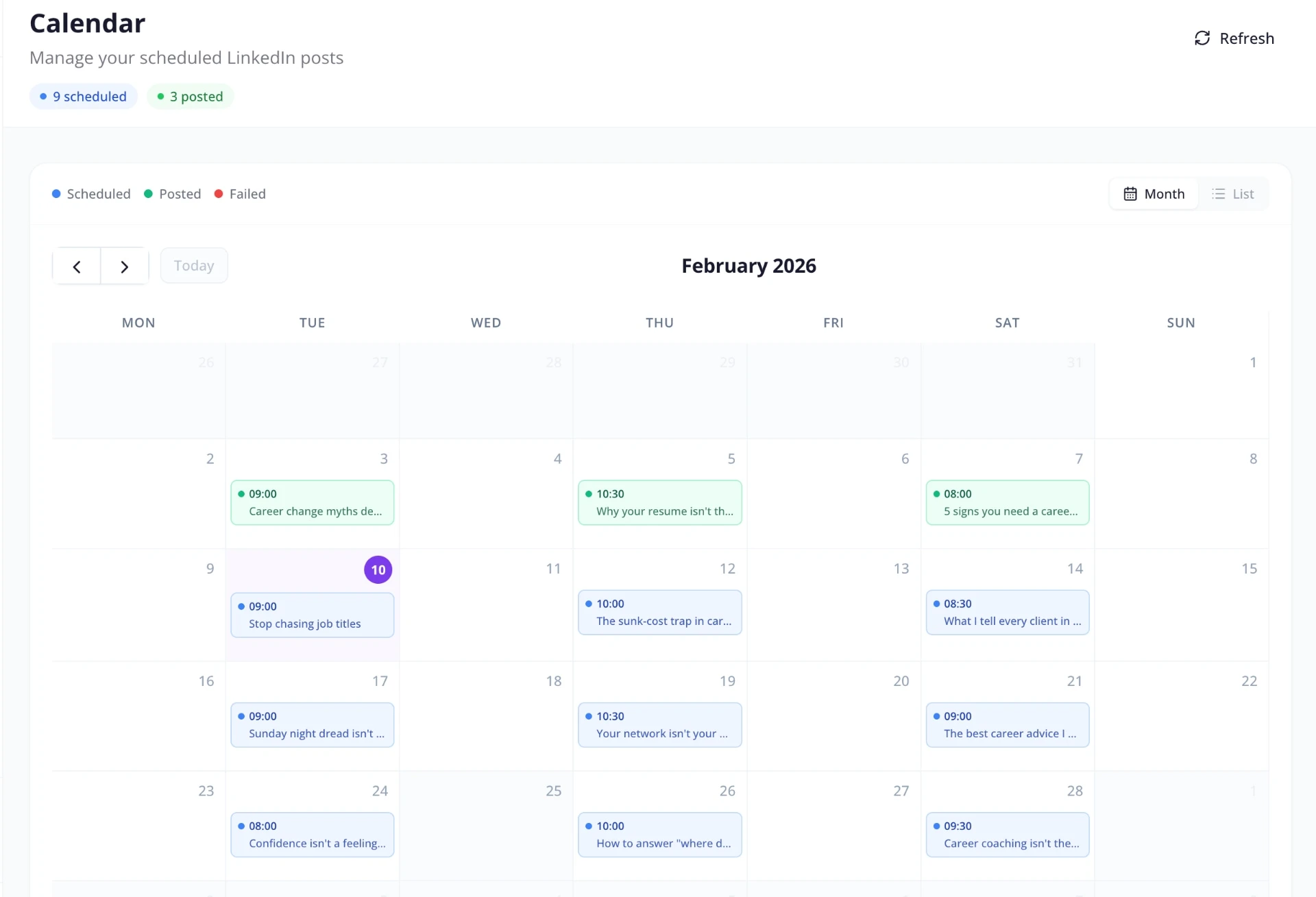
Use LinkedIn's native scheduler to queue posts in advance. Posting at consistent times, many coaches find Tuesday and Thursday mornings work well, helps the algorithm learn your rhythm. After each post goes live, spend 15-20 minutes actively responding to comments. The first hour matters most for reach.
How do you know if your LinkedIn content strategy is working?
There's a distinction worth making clearly before you start tracking anything:
Vanity metrics feel good but don't predict revenue: impressions, follower count, post likes. A post that gets 50 likes from other coaches isn't performing, it's popular in the wrong room.
Track these instead:
Metric | What it tells you | Healthy benchmark |
|---|---|---|
Profile visits per week | Whether content is driving curiosity | Increasing week on week |
Connection requests from ideal clients | Whether you're reaching the right people | 5-10 per week at scale |
Inbound DMs | Whether content is building enough trust to prompt action | 1-3 per week is strong |
Discovery calls from LinkedIn | The actual business metric | Depends on your capacity |
Common mistake
Evaluating your LinkedIn strategy before 90 days of consistent posting. Month one almost always looks like nothing is happening. The coaches who quit at week six never see month three, which is usually when the compound effect becomes visible.
Don't evaluate results before 90 days of consistent posting. Month one often looks like nothing is working. Month three usually tells a very different story. Understanding which LinkedIn analytics actually matter for coaches helps you focus on the numbers that predict client enquiries, not the ones that feel good to screenshot.
How does CoachCraft fit into a LinkedIn content strategy?
CoachCraft was built specifically because the system above, while straightforward on paper, is genuinely hard to maintain when you have a full client load. The topic bank runs dry. The batching session gets cancelled. The posting cadence slips for three weeks and you lose momentum.
CoachCraft handles the parts that drain coaches most. It generates content ideas based on your coaching niche, your methodology, and what your ideal clients are searching for right now. It writes posts in your voice, not a generic coaching voice, based on a tone profile built from how you actually communicate. You review, adjust, and publish. The thinking and writing happen in minutes instead of hours.
The coaches who use it most effectively treat it as a content partner, not a content machine. They bring the insight from a session, a client moment, or a contrarian opinion. CoachCraft turns that raw material into a finished post that sounds like them.
CoachCraft has a unique way of making your posts sound like you. Not only do we analyze your past LinkedIn posts, we also have the option to record your actual spoken voice and extract your voice profile from that. This is one of the key reasons why coaches prefer CoachCraft over other content tools.

Why does engagement matter as much as publishing on LinkedIn?
LinkedIn is not a broadcast platform. Posting and disappearing is one of the most common ways coaches underperform on content that would otherwise work.
Comments are worth significantly more than likes in LinkedIn's algorithm. A post with 10 thoughtful comments reaches more people than a post with 100 likes and no conversation. Your job after hitting publish isn't done.
In the first 60-90 minutes after a post goes live, respond to every comment, not with 'thanks!' but with something that continues the conversation. Ask a follow-up question. Share a related observation. Disagree respectfully if the comment warrants it. Each reply re-triggers a small algorithmic boost and deepens the relationship with someone who was already engaged enough to write something.
The second part of engagement is commenting on other people's content. Spending 15 minutes commenting thoughtfully on posts from people in your ideal client's world, HR directors, senior managers, career-changers in your niche, puts your name and perspective in front of exactly the right audience. When those people click through to your profile, they arrive already primed by the quality of your thinking.
The DM strategy that converts LinkedIn engagement into coaching clients covers what to do after someone engages repeatedly with your content, how to move from comment thread to conversation without it feeling like a pitch.
How do you build a LinkedIn audience worth having as a coach?
A large following of the wrong people is worse than a small following of the right ones. When you post content designed to maximize likes rather than resonate with your ideal client, you attract people who like that kind of content, other coaches, motivational content enthusiasts, people who engage with everything. That audience feels good and delivers nothing in practice.
Building the right audience means being specific enough that the wrong people self-select out. A career coach who posts exclusively about the experience of professionals in their 40s who have done everything right but feel stuck will have a smaller audience than a coach posting generic professional development tips. But when that specific coach posts, the people who read it feel like it was written about them. Those are the people who book calls.
Don't chase followers, chase relevance. Send connection requests to people who match your ideal client profile, not to other coaches, not to LinkedIn influencers, but to the actual humans you'd want to work with. When your connection base shifts toward your ideal client, your posts get shown to more of them. Growing your LinkedIn audience from zero as a coach covers the early stages of this in detail, including how to build momentum when you're starting with a small network.
Bas and the coaches at The Passion Profile have watched this play out across more than 40 coaches building their LinkedIn presence when they created the first version of CoachCraft. The ones who gain momentum fastest aren't the ones with the most polished content. They're the ones who know exactly who they're talking to and write as if that person is sitting across from them.
A great example of this was Roy, a career coach who started posting consistently and after 3 months suddenly got 3 new clients that all mentioned they had been following him on LinkedIn.
Frequently asked questions
How long does it take to get clients from LinkedIn as a coach?
Most coaches see their first inbound enquiry from LinkedIn content between 6 and 12 weeks of consistent posting at 2-3 times per week. The timeline depends heavily on how well your content speaks to your ideal client's specific situation, not just on how often you post.
Should coaches use hashtags on LinkedIn?
Yes, but sparingly. Three to five hashtags per post is enough. Mix broad tags (#coaching, #careercoaching) with niche-specific ones. Hashtag-driven discovery is less powerful than it was in 2023, but they still provide a small visibility boost and signal topic relevance to the algorithm.
Is it better for coaches to post on a personal profile or a company page?
Personal profile, without question. LinkedIn's algorithm gives significantly higher organic reach to personal profiles than company pages. Coaching is a relationship business, people hire the coach, not the brand. Your personal presence is the product.
How do coaches find content ideas when they feel stuck?
The best source is the session you just finished. What question came up that you've answered ten times before? What shift happened that surprised you? What belief does your client hold that you consistently push back on? Those are your posts. Turning coaching sessions into content covers this in detail.
Should coaches respond to every comment on their LinkedIn posts?
Yes, especially in the first hour. Responding to comments signals to LinkedIn's algorithm that your post is generating conversation, which extends its reach. It also starts the relationship with people who are actively engaging with your ideas, those are your warmest potential clients.
How do coaches measure LinkedIn ROI?
Track profile visits, inbound DMs, and discovery calls booked from LinkedIn, not likes or follower count. A post that gets 8 likes but prompts 2 DMs from ideal clients is outperforming a post that gets 200 likes from people who will never hire you.
What's the difference between a LinkedIn post and a LinkedIn article for coaches?
Posts are short-form (under 3,000 characters) and get higher immediate reach. Articles are long-form and get lower immediate reach but compound over time through LinkedIn search. Start with posts. Add articles once your posting habit is established and you have specific topics worth 1,000+ words.
Can coaches use AI to write LinkedIn content?
Yes, with the right approach. Generic AI tools produce generic content, which is the fastest way to sound like every other coach. The coaches who use AI effectively treat it as a writing partner: they bring the insight, the story, and the opinion. The AI handles the drafting. Keeping your authentic voice when using AI for coaching content covers what works and what doesn't.
Create LinkedIn Content That Converts
Join career coaches using CoachCraft to build their LinkedIn presence.
Get Started Free